May 18
 Note: Please double click on cover 'Veera kaaviyam May 18'
 Airports Close for Second Day as Ash Spreads Across Europe
By ALAN COWELL, NICOLA CLARK and MARK McDONALD
April 15, 2010
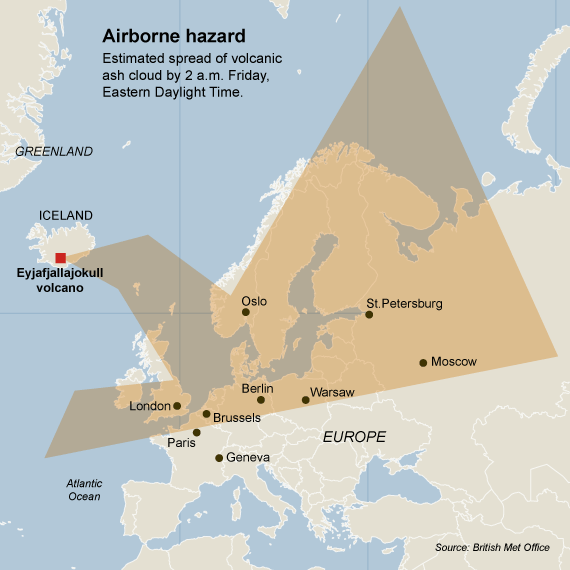
PARIS — Air travel chaos across the globe deepened on Friday as a vast, high-altitude plume of volcanic ash from Iceland spread farther across northern and central Europe, forcing the authorities to close airspace and ground airplanes to forestall potentially dangerous damage to jet engines.
By Friday morning, most of Europe’s major airports — crucial hubs for international travelers — were closed. Thousands of flights had been canceled since the disruption began on Thursday, stranding or delaying millions of passengers from North America to Asia.
“I’ve never seen such chaos,” said Erich Klug, 35 , a buyer for an auto parts company who was stranded at the Frankfurt airport after it closed down on Friday. Hundreds of people there stood in line to buy train tickets for onward travel.
Aviation authorities said there was no prospect of a return to normal flights until Saturday at the earliest, raising questions about a wide range issues from the economy and business to family vacations and even to whether President Obama would be able to fly to the funeral on Sunday of the Polish president and his wife, killed in an unrelated air crash last week.
Neither did the volcanic eruption in Iceland seem to be easing. At 6 a.m. Friday local time, the Volcanic Ash Advisory Center reported in London, there was still “significant eruption continuing.” The volcano erupted Wednesday for the second time in a month, forcing evacuations and causing flooding about 75 miles east of Reykjavik, Iceland’s capital. Icelandic airports remained open because they are west of the volcano and wind was blowing the ash away to the south and east.
For the first time, an international agency warned on Friday of potential health risks. In Geneva, the World Health Organization said people with respiratory problems should “limit their activities outdoors or stay indoors” if ash started falling from the sky.
 In a telephone interview, a spokesman, Dan Epstein, said there were no apparent health risks if the ash stayed in the upper atmposphere. But if the ash reached the ground, people with illnesses such as asthma, emphysema and bronchitis could be at risk.There have been no reports of significant amounts of ash falling on densely populated areas.
 At Frankfurt airport, Dominique Spiesser, 54, a chemical engineer from Switzerland who was on a business trip in India, said he only learned that the airport was closed after his flight landed early Friday.
Dozens of countries held nuclear materials that could be sold or stolen, and that a weapon fashioned from an apple-size piece of plutonium could kill or injure hundreds of thousands of people.
“Terrorist networks such as Al Qaeda have tried to acquire the material for a nuclear weapon, and if they ever succeed, they would surely use it. Were they to do so, it would be a catastrophe for the world.” Mr. Obama
Obama Calls for Joint Action to Safeguard Nuclear Stocks
April 13, 2010
Obama Calls for Joint Action to Safeguard Nuclear Stocks
By DAVID E. SANGER and MARK LANDLER
WASHINGTON — Saying that the prospect of nuclear terrorism had emerged as one of the greatest threats to global security, President Obama called on world leaders “not simply to talk, but to act” to secure or destroy vulnerable stockpiles of nuclear materials.
Mr. Obama, addressing a plenary session of the 47-nation nuclear security conference he had convened here, told fellow leaders Tuesday morning that it was time “not simply to make pledges, but to make real progress for the security of our people.”
“All this, in turn, requires something else, something more fundamental,” Mr. Obama continued. “It requires a new mindset — that we summon the will, as nations, as partners, to do what this moment in history demands.”
Seeking to lend force to his warning, Mr. Obama said that dozens of countries held nuclear materials that could be sold or stolen, and that a weapon fashioned from an apple-size piece of plutonium could kill or injure hundreds of thousands of people.
“Terrorist networks such as Al Qaeda have tried to acquire the material for a nuclear weapon, and if they ever succeed, they would surely use it. Were they to do so, it would be a catastrophe for the world.”
A day after Ukraine, Canada and Malaysia offered individual undertakings to tighten controls or reduce nuclear stocks, Mr. Obama said that “the problems of the 21st century cannot be solved by nations acting in isolation — they must be solved by all of us coming together.”
Joint undertakings toward that end will be spelled out in a communiqué from the group to be issued at day’s end, and more individual commitments are expected as well.
Mr. Obama also announced that there would be another nuclear security conference in two years, and that the president of South Korea, Lee Myung-bak, had agreed to be the host. That would seem to ensure a particularly close focus on the North Korean nuclear program, just as Iran has drawn particular attention at this meeting.
On Monday, Mr. Obama secured a promise from President Hu Jintao of China to join negotiations on a new package of sanctions against Iran, administration officials said, but Mr. Hu made no specific commitment to backing measures that the United States considers severe enough to force a change in direction in Iran’s nuclear program.
In a 90-minute conversation here, Mr. Obama sought to win more cooperation from China by directly addressing one of the main issues behind Beijing’s reluctance to confront Iran: its concern that Iran could retaliate by cutting off oil shipments to China. The Chinese import nearly 12 percent of their oil from Iran.
Mr. Obama assured Mr. Hu that he was “sensitive to China’s energy needs” and would work to make sure that Beijing had a steady supply of oil if Iran cut China off in retaliation for joining in severe sanctions.
American officials portrayed the Chinese response as the most encouraging sign yet that Beijing would support an international effort to ratchet up the pressure on Iran and as a sign of “international unity” on stopping Iran’s nuclear program before the country can develop a working nuclear weapon.
On Tuesday, though, Chinese officials in Beijing seem to strike a more cautious note.
“We believe that the Security Council’s relevant actions should be conducive to easing the situation and conducive to promoting a fitting solution to the Iranian nuclear issue through dialogue and negotiations,”
Jiang Yu, a foreign ministry official, said at a regular news briefing in Beijing.
“China supports a dual-track strategy and has always believed that dialogue and negotiations are the optimal channels for resolving the Iranian nuclear issue. Sanctions and pressure cannot fundamentally resolve the issues.”
Iran’s state-financed Press TV satellite broadcaster highlighted news agency reports saying that China still favored diplomacy to resolve dispute over Tehran’s nuclear intentions.
The developments had distinct echoes of former President George W. Bush’s three efforts to corral Chinese support for penalties to be imposed on Iran by the United Nations Security Council. Those penalties were intended to make it prohibitively expensive for Iranian leaders to enrich uranium or to refuse to answer questions posed by international nuclear inspectors.
In those cases, former American officials said, the Chinese agreed to go along with efforts to address Iran’s nuclear ambitions, but then used Security Council negotiating sessions to water down the resolutions that were ultimately adopted.
Mr. Obama also used his meeting with Mr. Hu, the fourth face-to-face meeting between the leaders of the world’s largest economy and its biggest lender, to keep up the pressure on Beijing to let market forces push up the value of China’s currency. That is a critical political task for Mr. Obama, because the fixed exchange rate has kept Chinese goods artificially cheap and, in the eyes of many experts, handicapped American exports and cost tens of thousands of American jobs.
In anticipation of Monday’s meeting, Chinese officials told Treasury Secretary Timothy F. Geithner last week that they were about to resume a controlled loosening of their exchange rate, which would increase the relative costs of Chinese exports.
Mr. Obama’s senior Asia adviser, Jeffrey A. Bader, told reporters after the meeting on Monday that Mr. Obama told Mr. Hu that a market-oriented exchange rate would be “an essential contribution” to a “sustained and balanced economic recovery.”
The session with Mr. Hu came just before the opening of the first summit meeting devoted to the challenges of keeping nuclear weapons and material out of the hands of terrorists. At a dinner Monday evening in the cavernous Washington Convention Center, Mr. Obama led a discussion of the nature of the threat and the vulnerability of tons of nuclear material that could be fashioned into a weapon.
Earlier in the day, John O. Brennan, Mr. Obama’s top counterterrorism adviser, offered a sampling of Mr. Obama’s argument when he told reporters that the United States had continuing evidence of Al Qaeda’s interest in obtaining highly enriched uranium or plutonium, the only materials from which a nuclear weapon can be made, and that it would be used “to threaten our security and world order in an unprecedented manner.”
But he cited no incidents beyond the now-famous campfire conversations that Osama bin Laden held in August 2001 with two Pakistanis who had deep ties to Pakistan’s nuclear weapons laboratories. While Al Qaeda has tried repeated purchases, Mr. Brennan said, “fortunately, I think they’ve been scammed a number of times, but we know that they continued to pursue that. We know of individuals within the organization that have been given that responsibility.”
The main focus of Mr. Obama’s meeting is to obtain commitments from each of the 47 countries attending to lock up or eliminate nuclear material.
One such agreement was announced Monday with Ukraine which, after the fall of the Soviet Union, was, because of its remainder stockpiles of nuclear missiles and bombs, briefly the world’s third-largest nuclear power. It gave up the arsenal, but for the past 10 years had resisted surrendering its stockpile of highly enriched uranium, held at research reactors and another nuclear center.
The Nuclear Threat Initiative, a nonprofit group that studies proliferation, has estimated Ukraine’s stockpile at about 360 pounds, or roughly enough for seven weapons.
According to a senior administration official, under the deal announced Monday the United States will pay to secure the highly enriched uranium, which will probably be sent to Russia for conversion into low- enriched uranium for nuclear power plants. As part of the deal, the United States will also help supply Ukraine with new low-enriched fuel and a new research facility.
But over all, it was Iran that dominated the day, because the administration has a goal of putting sanctions in place this spring, Mr. Obama said in an interview with The New York Times last week.
On Monday, Mr. Obama laid out the details of the sanctions package for Mr. Hu, according to a senior White House official familiar with the discussion. These are likely to include additional measures to deny
Iran access to international credit, choke off foreign investment in Iran’s energy sector and punish companies owned by the Islamic Revolutionary Guards Corps, which controls swaths of Iran’s economy, as well as its nuclear program.
The administration is betting that a large segment of Iranian society detests the Revolutionary Guards for its role in suppressing the protests that followed elections last June, and may welcome properly targeted sanctions.
“Until two weeks ago, the Chinese would not discuss a sanctions resolution at all,” the official said. But the Obama administration, in hopes of winning over Beijing, has sought support from other oil producers to reassure China of its oil supply. Last year, it sent a senior White House adviser on Iran, Dennis B. Ross, to Saudi Arabia to seek a guarantee that it would help supply China’s needs, in the event of an Iranian cutoff.
“We’ll look for ways to make sure that if there are sanctions, they won’t be negatively affected,” said the senior official.
There was little evidence in the meeting of the succession of spats that have soured Chinese-American relations over the last several months, American officials said. While Mr. Hu raised Chinese complaints about American weapons sales to Taiwan, an official said, he did so fleetingly. And he did not mention Mr. Obama’s decision to meet the Tibetan spiritual leader, the Dalai Lama.
Brian Knowlton, contributed reporting from Washington, Andrew Jacobs from Beijing and Alan Cowell from Paris.
*Fonseka warned against speaking to international bodies on ‘war crimes’:PTI
*Mahinda Rajapaksa: Unwise Actions Could Endanger Democracy: B.Raman
*No link between Fonseka arrest and run for prez: Lanka envoy
========================================
News » International
Colombo, February 11, 2010
Fonseka warned against speaking to international bodies on ‘war crimes’ PTI
Sri Lankan government has warned the detained ex-army chief Sarath Fonseka against providing “evidence to certain international organisations” on alleged war crimes during the final battle with LTTE as it took strong exception to his remarks that he would “reveal the truth“.
“He has reportedly spoken regarding certain things that took place during the war. He also said he is going to provide evidence,” Media Minister Lakshman Yapa Abeywardene said.
“If he (Fonseka) is going to give evidence to certain international organisations regarding incidents that have taken place after the war was initiated then I believe that the army has the right to question such a military officer,” he told reporters, without naming the global bodies.
Wimal Weerawansa, the chief of the National Freedom Front, a partner of the ruling United People’s Freedom Alliance (UPFA), also cautioned Gen. (Retd.) Fonseka on the issue.
“Why is a doubt being created in the world? He (Fonseka) was not the one who commanded all the forces,” Mr. Weerawansa said on Wednesday, implying that the General was only responsible for army that time as its head, and not for Air Force and Navy.
“The state leader or someone in the political arena can say this. If something has taken place and you are revealing it, then we will make inquires about it. However, for a former army commander, who was there during the war, to make these revelations, it is a betrayal,” he said.
Prior to his detention, Gen. (Retd.) Fonseka had said on Monday that he was “not going to save anyone who has committed war crimes,” according to BBC Sinhala service.
International human rights organisations as well as the U.S. State Department had alleged that Sri Lankan security forces committed war crimes during the final phase of the war against Tamil Tigers.
"I am definitely going to reveal what I know, what I was told and what I heard. Anyone who has committed war crimes should definitely be brought into courts," Gen. (Retd.) Fonseka, who was trounced by incumbent Mahinda Rajapaksa in the January 26 Presidential polls, had said.
============================================
Paper no. 3660
11-Feb-2010
Mahinda Rajapaksa: Unwise Actions Could Endanger Democracy
By B. Raman
After having won an impressive victory over Gen.Sarath Fonseka, his former Army chief, in the prematurely called Presidential elections on January 26, 2010, President Mahinda Rajapaksa has got the Parliament dissolved before it had completed its term so that fresh elections to a new House could be held. The new elections are scheduled to be held on April 8, 2010.
2. It seems to be his hope and calculation that his party and others supporting him would win an equally impressive victory in the elections to the Parliament by taking advantage of the confusion prevailing in the ranks of the opposition after the defeat of Fonseka in the Presidential elections. If his hopes are realised, this will enable him to undertake a programme for finding a solution to the grievances of the Tamils and putting Sri Lanka back on the road to economic recovery.
3. Mr.Rajapaksa was within his rights in calling for premature parliamentary elections and nobody could have objected to his action. What is, however, highly objectionable is the manner in which the President and his two brothers----Mr.Gothbaya Rajapaksa and Mr.Basil Rajapaksa---- have been trying to humiliate Gen. Fonseka and intimidate his supporters apparently in order to ensure that the votes, which Fonseka got in the Presidential elections, do not get translated into votes against Mr.Rajapaksa's party and its electoral allies.
4. A campaign of intimidation and vendetta was started against Fonseka and his supporters after the Presidential elections. Over a dozen officers of the Armed Forces----three of them Majors-General---- have been sacked on national security grounds without specifying the reasons in detail. They were apparently suspected of being loyal to Fonseka and not to the President.
5. The purge of Fonseka's supporters in the Armed Forces was followed by the arrest of Fonseka himself in an undignified manner despite the fact that he was the chief of the Army and had displayed commendable leadership qualities in having the LTTE crushed. Fonseka himself once narrowly escaped being killed by the LTTE. This showed how the LTTE considered his elimination important for achieving its objective.
6. While many people-----including the President himself and his two brothers-----played an important role in the elimination of the LTTE, the role of Fonseka and his come-back after almost having been killed by the LTTE fired the imagination of the officers and other ranks in the Armed Forces and made them fight as a team with determination against the LTTE. When the history of the victory over the LTTE is written, Fonseka's generalship would stand out in any account.
7. In its long history, the Sri Lankan army had not produced many heroes to whom the soldiers can look up to for inspiration. Fonseka was an exception as a professional soldier. Apparently blinded by political ambition after the victory over the LTTE, Fonseka conducted himself in an erratic and irresponsible manner and tried to play down the role of the President and his brothers and others in the victory.
8. His over-sized pride in himself and in his role and the bad advice which he received from those around him made him cross the limits of decency and loyalty and make wild allegations against the President and Mr.Gothbaya, who, as the Defence Secretary, co-ordinated the operations against the LTTE.
9. Mr.Rajapaksa had valid reasons to be angry against the General, but he has allowed the anger to get the better of him. His post-election actions against the General---including the circumstances of his arrest in an undignified manner not under the ordinary laws of the land, but under the special laws governing the Armed Forces and his plans to have him court-martialed under charges relating to violations of national security when he was a serving General have given rise to suspicions of a vendetta against the General for having dared to criticise the President and his brothers and for letting himself be used by the opposition in an attempt to have Mr.Rajapaksa defeated in the Presidential elections for a second term.
10. One could also discern an attempt by Mr.Rajapaksa and his brothers to make it difficult for Fonseka to influence the forthcoming Parliamentary elections by keeping him in detention fighting cases started against him by the Government. Mr.Rajapaksa does not seem to realise that his actions could not only create public revulsion for his style of functioning, but could also sow the seeds for the politicisation of the Sri Lankan Army and make it go down the way of the Armies of Pakistan and Bangladesh.
11. The political leaders of Pakistan and Bangladesh cannot escape their share of responsibility for politicising their armed forces and facilitating the military dominance of the political life of their countries by actions which were exploited by the Army to project the political class in a bad light.
12. If democracy has till now survived and flourished in Sri Lanka, an important contributing factor was the wisdom shown by the predecessors of Mr.Rajapaksa in maintaining the professionalism of the Army and keeping it politically neutral. By deviating from the path of wisdom followed by his predecessors and by conducting himself in the manner he has been doing due largely to sheer spite, Mr.Rajapaksa has already broken the healthy traditions which had won Sri Lanka the respect of the international community.
13. If Mr.Rajapaksa does not pull himself back and refrain from such vindictive actions, there is a danger of Sri Lanka meeting the fate of Pakistan and Bangladesh due to the unwise actions of Mr.Rajapaksa and his brothers.
==============================================
No link between Fonseka arrest and run for prez: Lanka envoy
Sachin Parashar, TNN, 10 February 2010, 03:54am IST
NEW DELHI: A day after the arrest of former army chief Sarath Fonseka, Sri Lankan high commissioner to India Prasad Kariyawasam said the development would have no adverse effect on the island nation’s stability as the charges against Fonseka are not linked to his status as the main opposition candidate in the January presidential elections. Fonseka’s arrest is being looked upon by many as a crackdown on President Mahinda Rajapaksa’s opponents in the run-up to parliamentary elections.
"It is important to not see a link between his candidature in the presidential polls and the arrest which is a part of a separate process altogether. There are serious allegations of misconduct as a military officer against him and the investigations into these are bound by military rules," said Kariyawasam in an exclusive interview to TOI, adding that only the investigations will determine the exact form of charges to be pressed against him.
While Kariyawasam said the process of devolution of power to Tamils is already underway, he admitted it could be delayed by the fact that there is no real leadership currently among the Tamils.
"We and India are on the same page over empowering people in the north and east. However, the fact is that we need a new Tamil leadership to emerge. We can’t work with diaspora groups who are enamoured by the idea of separatism," said Kariyawasam, adding Sri Lanka needed more time as the war was just over. He was responding to a query on how seriously Rajapaksa would take his commitment on devolution in the face of his resounding win over Fonseka who was backed by the Tamils.
As for the resettlement, he said there were only about 70,000 refugees living in military camps now. "Even among these there are many who are living there because the camps have good facilities," he said.
Kariyawasam also sought to allay India’s concerns over the growing Chinese influence in Sri Lanka and that the firmly entrenched Rajapaksa might use the proximity with China as a leverage against India. He said India will always be the most important country for Sri Lanka. "There is a misperception. Our friendship with China is not at India’s expense. Sri Lanka will never do anything which will harm India’s strategic interest," he said.
"We have a commercial and profitable partnership with China which should make India happy too because it will lead to overall development which, in turn, will help Indian firms who are investing in Sri Lanka," he added.
 To view a video please double click on the above picture.
Gen. Fonseka was forcibly dragged away from his office February 8th, 2010
By D.B.S. Jeyaraj
In a disturbing turn of events, retired four star General Sarath Fonseka was taken into custody by a contingent of military police on the night of Monday, February 8th 2010.
 President's Speech at the 62nd Independence Day
Feb 4, 2010
Today we celebrate the anniversary of Independence after the liberation of the entire country from terrorist threat for the first time in 30 years. I am proud to proclaim that we are in a position to raise the flag of Sri Lanka with dignity in the entire country.
In 1815, Variyapola Sumangala Thero hoisted our flag on this historic land after lowering the Union Jack. I wish to pay my respect to the venerable monks as well as the revered clergy of all religions for their dedication and commitment displayed to preserve this freedom.
When I unfurled the national flag today, I remembered those heroic soldiers who sacrificed their lives and limbs for the freedom of the country and all those who worked with dedication for the liberation struggle.
Friends,
Freedom is a responsibility. The people of this country have entrusted me with that responsibility on January 26 by a larger majority than in the 2005 Presidential election. I would like to assure you that I will fulfill that trust placed upon me.
Accordingly, it was demonstrated to the world that for us the Motherland is first, second and third. Thus, we have become richer with the supreme human quality of gratitude. It is my fortune to fight along side people with such great qualities to preserve the freedom of our nation. It is indeed a privilege to live in a country with such intelligent people. I am fortunate to be the leader of a country of fathers, mothers and children who know the value of gratitude.
I have succeeded in uniting the territory. Now, I am entrusted with the task of uniting the hearts of all sections of our people. I willingly take over the noble task of creating peace among our communities.
The first Prime Minister, Rt. Hon. D. S. Senanayake stated on the occasion of the first Independence Day that the meaning of freedom is to curtail sorrows and enhance happiness. That is the desire of the people when a country attains independence. I would like to point out that the past four years was the most meaningful era of freedom since we attained independence.
Friends,
This is the time when the benefits of unifying the nation begin to show results. Now that the war has ended, the nation is saving more than the cost of the war. International research magazines recently reported that Sri Lanka is among the 31 countries in the list of best tourist destinations. Sri Lanka is second only to China among Asia's fastest growing economies. Sri Lanka is also listed among the best countries for investment. We cordially invite investors here.
We were able to gain such achievements because infrastructure was speedily built whilst the war was being waged. I will use this mandate given by you to re- establish all that was lost for the past 30 years due to the war.
Our country which fell back in progress because of the war needs to be advanced swiftly. Peace alone is not enough. An efficient, advanced nation needs to be built to replace a country which is lazy, lethargic and lacks energy. It is meaningless to blame our nation for its inefficiency whilst referring to the efficiency and progress of other countries. We proved at the recent overwhelming victory that our people could overtake them.
In the development of the country the private sector too has a responsibility similar to that of the public sector. There is a better environment for the private sector which was at a standstill during the war. I expect a public service which can take quick decisions and which is people friendly. I will make the government service a service for the public.
You are aware that during the operation to defend the country, I protected the heroes who fought for the country. I represented them everywhere. And now in the nation building process, I will protect the honest and skilled people who work for the betterment of the country. The country cannot be developed with harassment, gross punishments or by the gun. Discipline is not revenge. The nation can only be built through commitment, discipline and elimination of corruption.
In the Mahinda Chintana, we mentioned that Sri Lanka will be made a centre of marine, aviation, commercial, energy and knowledge. You may feel that this target is very far. But we will bring the benefits of these five great economic forces closer to your feet in the near future in order to end the era of sorrow and tears. We will give more opportunities to artistes, authors, musicians so that the yield of their creativity would enhance the contentment of the society.
We will make this a country where people return to, instead of leave for fear of life or poverty. We need to remove the bureaucratic hurdles on the path to economic development as we removed road barriers. My people were at a standstill for thirty years because of terrorists. Now this era is over. We will create a country where people can live at ease.
I implore the separatist forces and local and international conspirators not to underestimate our motherland and the people of this nation.
Friends,
We have brought massive development to the North and East regions as never witnessed in history after removing their fear of death. Uthuru Vasanthaya (Northern Spring) and Nagenahira Navodaya (Eastern Awakening) are some of the major development projects in the country.  The people of the North and East suffered for thirty years without their democratic rights. I was able to grant them democracy. That is the greatest victory we have achieved.
We do not strengthen the parties based on divisive politics on the basis of colour or tribe, pro- LTTE or separatist.
I am certain that the people in the North and East could stand on their own feet through a solution wrought by devolving powers to the villages and empowering them in the entire country.
In accordance with Mahinda Chintana: Vision Ahead, I believe that discussions should be held with the people and their representatives of those areas to find solutions and take action as necessary.
(In Tamil)
My dear people
Today is our Independence Day. It is a very happy day for all of us. Thirty years of terrorism is now over. We are celebrating our independence in such an atmosphere for the first time. Now all of you can live in consolation without fear or doubt.
Anyone can go anywhere freely. That is very important. This is our motherland. All of us are children of one mother. All of us are kings today. We all should live together as brothers with equal rights and with dignity. Let us discuss our issues among ourselves and resolve them.
Everyone will receive all facilities in equal manner. That is called equality and equal rights.
One country, one people, one law. That is our way, the only way.
Thus, there is no racism, separatism or terrorism. Never forget the motherland; never betray it. We consider no one in our country as a minority person. All those who love the country are children of Mother Lanka.
Our motherland is emerging as a hub of development. Democracy should be protected forever.
Recently, the people of Northern and Eastern provinces too were able to vote democratically. I am very pleased about it. Politicians should not mislead the innocent people.
Hereafter, we will not entertain narrow divisions based on race, religion, language and political ideology in terms of regions. Never leave room for the politics of hate. Peace, brotherhood, co-existence and prosperity -- that is our prime objective.
Let us join together. Let us build this country for the sake of our future generations.
(end of Tamil text)
Friends,
You all are aware that our foreign policy is independent and non-aligned. It is no secret that we have maintained close friendly relationships with our neighbours such as India, China, Japan and others. We also maintain close affinity with Africa, the West, the Middle East and the European countries.
In my foreign policy, whatever I have done was in the interest of the people of this country. Now the world should have a correct opinion about us. The Tiger terrorism that impacted on other countries too has ended. The state of war is now over. We are entering into a new era of co-existence after finishing the period of some controversy. I would like to say that we are now entering the golden era of international relations.
Friends,
I never thought of gaining political mileage and take decisions that betrayed the nation. I will never betray the country. The decisions I took from the time when I decided to defeat terrorism, were taken while thinking of the country's welfare. I did not think of political power when I took decisions. I did not take decisions to implement major projects; the Norochcholai coal power station and Upper Kotmale hydroelectric project to obtain foreign assistance to stay in power. I have done this for the development of the country. I have done this because those are essential for the country. We will not surrender even an inch of territory from our Motherland. As I have always said, we will not take even a single step backwards to stay in power. On the other hand, we will go forward many steps under any difficult conditions in the interest of the nation.
My feet were worn out by walking in long marches with my people. I have sweated in the fight for the rights of the working class. My voice was trained and tuned to rise up against injustice.
I spent my free time listening to the grievances of the common people. The only time I could not listen to the problems of the common people was when I was imprisoned for fighting for the democratic rights of the people. Our house has become a home for the common people. Today, the luxurious carpets at the Temple Trees affectionately receive the feet of common people.
I did not ask you to crown me. However, please remember that I have placed the crown of freedom, prosperity and heroism on the heads of you and your children.
I have understood the fatherly love and affection of your sons and daughters for me. The affection of the sons and daughters of this country was an enormous blessing for me.
It was on this historic place that Veera Keppetipola sacrificed his life without any fear, for the freedom of the nation. I believe that the leaders who ruled this nation should have a heart which will not betray the country similar to that of Veera Keppetipola.
Now I am addressing you from the place where the child hero, Madduma Bandara, son of Keppetipola's sister, sacrificed his life without display of any fear. Please remember that the hearts of your sons and daughters too are filled with unlimited love for the motherland similar to that of Madduma Bandara. Your sons and daughters have unlimited love for me for the same reason.
I feel I am the world's luckiest leader of state to earn the love and affection of such a heroic and talented generation of children.
Friends,
Please protect your child who grows up with love for the country. We have to build a society where your sons and daughters could live with knowledge and good values. It is for our children that we build this nation to be the Pride of Asia.
I wish you a prosperous future.
May the Triple Gem bless you and the blessings of the Sacred Tooth relic be with you.
Courtesy: GDI